Case
Everyone in the room
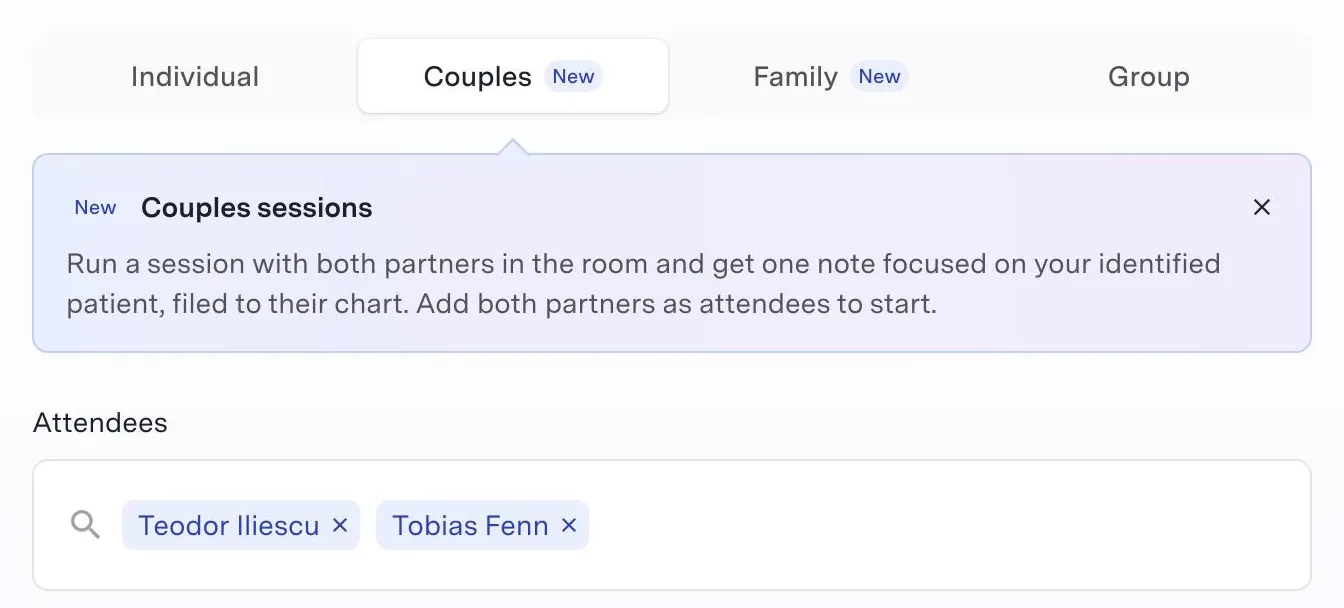
The AI wrote one note per session. Then four people walked into the room.
- Role
- Led design, end to end
- Span
- July–October 2026
- Stakes
- In insurance-billed therapy, the note is the evidence for the claim, and a note on the wrong chart hands a reviewer a reason to deny it.
- Decision
- Generate every note first and pause only for a silent attendee; notes follow identified patients, not session format.
- Outcome
- Couples and family shipped to every clinician; groups are in development, and the first practice to see them asked for a dedicated demo.
Step 1 of 4
One confirmation, scaled to the mess
One confirm step before generation, lighter or heavier depending on how messy the session was. It already folded an earlier interruption into a step clinicians had to complete anyway.
What changed my mind: Engineering showed regeneration was the only expensive operation, so gating every session spent clinicians’ time to avoid a cost that rarely happened.
Step 2 of 4
Hold only when the count is wrong
Generate immediately unless the number of speakers didn’t match the number of attendees.
What changed my mind: Our clinical lead pointed out that clinicians often leave speakers unlabeled on purpose, and without voiceprints the hold would ask the same question every week.
Step 3 of 4
No hold for unknown voices
Unknown or unlabeled speakers never stop a note; they’re fixed afterwards, if at all.
What changed my mind: One question still changed how many notes should exist, so it couldn’t wait until after generation.
Step 4 of 4
One pause for a silent attendee
Generation stops only when someone on the roster never spoke, to ask whether they were there.
What kept it: It’s the only answer that decides whether a note should exist at all.